Showing posts with label heart issues. Show all posts

Saturday, August 23, 2008

Christian spirituality

In the context of speaking about 21st century spiritual trends in the Church that have dislocated spirituality from that of the ancient church, Webber notes how the experiential spirituality of pietism and revivalism have turned into narcissism. He says,

Evangelism's focus on God's story taking experiential root in our lives is in itself not narcissistic. It only becomes narcissistic when one becomes fascinated with his or her own journey and gives priority to self-reflection. Our contemplative wonder and awe is not to focus on the spiritual journey of the self but on the journey of God who creates and became incarnate in his own creation to re-create. And our participation in the spiritual life is not a continuous search for a transcendent experience but the transfiguration of this life through a life lived in the continual pattern of baptism - dying to sin and rising to the life of the Spirit.
-Robert Webber, The Divine Embrace
"The Christian way of knowing [the truth about God]," Webber says, "is reflection on Scripture [God's revelation about himself] within community [that lives God's revelation]."

And "spiritual theology," says Eugene Peterson, "is the attention we give to lived theology - prayed and lived, for if it is not prayed, sooner or later it will not be lived from the inside out and in continuity with the Lord of life."

According to Webber, the problem with much contemporary spirituality, Christian or otherwise, is that it is focused on and preoccupied with the self. In Christianity this is manifest in spiritualities of legalism, intellectualism, and experientialism. True spirituality is not only centered on God revealed in Christ, but proceeds from God's story of creation, incarnation-Christ's birth, life, death, and resurrection, and re-creation through the Spirit.

These differing perspectives will manifest themselves in how we interact over issues from worship styles and environmentalism, to ethical discrepancies, doctrinal disagreements, and relational conflict of all kinds. In short, what is at stake is the Gospel, which is the "power of God for salvation to all who believe, the Jew first and to the Greek."

Wednesday, March 05, 2008

Becoming "Unbusy"

At the beginning of the month I was reading a book by Eugene Peterson (author of The Message paraphrase of the Bible) called The Contemplative Pastor. In it Peterson talks about the need to clarify the role of a pastor with three adjectives: unbusy, subversive, and apocalyptic. Peterson takes much of the rest of the book to unpack those adjectives, so I won’t attempt that for you, but I will describe which one has been on my mind the most, the “unbusy” pastor. In the past couple of years I have become aware of my tendency to get busy doing stuff, especially ministry stuff, so that deep relationship with God and others moves to the periphery of my heart, mind, and schedule. In defining the “unbusy” pastor, Peterson made some observations that I really identified with. He said that often we are busy, not because we are selfless and noble, but because we are vain and lazy. We subconsciously think that we need to have a hand in everything around us, and we do not expend the mental and spiritual energy to focus on the things that God has called us to, saying “no” to the others. As an analogy, Peterson referred to the harpooner in the novel Moby Dick, quoting from Herman Melville’s commentary on harpooning: “To insure the greatest efficiency in the dart, the harpooners of this world must start to their feet out of idleness, and not out of toil.” Throughout the chaos of chasing the whale across the seas, the harpooner remained still, not caught up in all the activities of the ship, knowing that his time would come to practice his craft, and in order to be accurate he must be still. In reading this I immediately thought of both Psalm 46:10, “Be still, and know that I am God” and Isaiah 30:15, “In repentance and rest you shall be saved; in quietness and trust is your strength.” As I reflect on this past month of so much ministry activity, I wonder at how the Lord was teaching me to focus and minister from a place of still and quiet trust even amidst the chaos of so many things to do. At the beginning of the month I thought He was telling me to slow down, and now I am seeing that it is more a matter of the habits of my heart and intentionality in my schedule than it is about how filled my week is with activities. Now that things have slowed down, my prayer is that I will be busy practicing stillness before the Lord and focused “harpooning” throughout the days as I live out my calling here in Oklahoma.

Monday, February 11, 2008

Patience

Two quotes on patience that a friend of mine shared with me:

“God never hurries. There are no deadlines against
which He must work. Only to know this is to quiet our
spirits and relax our nerves.” A.W. Tozer

“The strength of patience hangs on our capacity to
believe that God is up to something good for us in all
our delays and detours.” John Piper

This is seriously needed, especially in my line of work when job descriptions are over-weighted with the lead-based expectations of "eternal urgency" and "kingdom consequences".

What is required of us but to do justly, to love mercy, and to walk humbly with our God in stillness and acknowledgment that He is God and we are not?

Wednesday, November 21, 2007

Confessions #9: the love of love

Having now traveled a few days into the Thanksgiving holidays, my little writing project has been set aside for other things that have been more immanent, namely our regional staff retreat with Campus Crusade for Christ staff and the normal catching up with the family. So, I may only have a couple of entries this week, but I hope they will overcome their poverty of quantity with a wealth of quality. ;)

Here I start on Book 3 of The Confessions, where Augustine recounts his coming to Carthage in 370 A.D as a young man of 16 to begin his formal studies. It was in Carthage that Augustine began his life of high culture, learning, and promiscuity. It was not until he reached 18 and read Cicero's Hortensius that it dawned on Augustine that happiness was not found in food, sex, and purely material pleasures. In that respect, there are not a few similarities between Augustine as a young male university student and the experience and temptations of many today. The lure and hunger for physical pleasure, notoriety, and and materialism are as alive today, or even more so, as they were in the fourth century. There is nothing new under the sun.

As it begins, Augustine recalls that he "came to Carthage and all around me hissed a cauldron of illicit loves. As yet I had never been in love and I longed to love." How often this is the situation for not only the modern college student, but even for those entering high school and even junior high. The "cauldron of illicit loves" has boiled over and filtered down through our tv's, computers, iPods, and lunchroom conversations. In that respect, I wonder if the cauldron burns hotter and broader than it once did in Augustine's day.

Augustine goes on to say, regarding the fact that he longed to love but had never been in love, that "from a subconscious poverty of mind I hated the thought of being less inwardly destitute. I sought an object for my love, I was in love with love, and I hated safety and a path free of snares." It should be said that Augustine's understanding of "love" was certainly age-appropriate and not the mature, self-giving sort of love that is true love, marital or otherwise. On reading these remarks at first, I didn't quite understand what Augusine meant by saying he "hated the thought of being less inwardly destitute." I thought that certainly he did not want to be more inwardly destitute. In Albert Outler's translation, we have Augustine saying it this way, "from a hidden hunger, I hated myself for not feeling more intensely a sense of hunger." So, it occurred to me that although Augustine had not experienced that love for which he longed, he was reflecting on the fact that he loved his desire for illicit love so much so that he hated that it was not stronger than it was. He thought the idea of his becoming less hungry for this illicit love as something to be despised and avoided altogether, and only later on did he realize that this was an indication, not of the virtue of his illicit hunger, but of its poverty and the magnitude of his real hunger beneath it for incorruptible love. Augustine loved his illicit hunger, not knowing that it would overtake him to consume him. He said,

"my hunger was internal, deprived of inward food, that is of you yourself, my God. But that was not the kind of hunger I felt. I was without any desire for incorruptible nourishment, not because I was replete with it, but the emptier I was, the more unappetizing such food became...I was glad to be in bondage, tied with troublesome chains, with the result that I was flogged with the red hot iron rods of jealousy, suspicion, fear, anger, and contention."

I have noticed this same inclination in my own heart, that I find many times that I am in love with desire, illicit or otherwise, to the exclusion of its object, the corruption of the purposes of desire itself, and the loss of real love. This affects relationships in the most radical way. Several years ago while interning with a youth group in near Houston, I realized during the Sunday morning worship time that my anxiety over how I "felt" during the singing time was really more an indication of me worshiping not the Lord who is to be worshiped but the experience of worship itself. It was and is an idolatry to be repented of, worshiping the relationship over the one I relate to, or in the words of Romans, "worshiping the creature rather than the Creator who is blessed forever." I also find this principle at work concerning human relationships, especially of the romantic kind, that I (I would say "we", but I dare only speak for myself) tend to love the experience of the relationship more than the one with whom I am in relationship. This is that very same self-centered destructive principle also at work in worship that I mentioned earlier, where we become "spiritually inbred". If Christ and his image is not at the center, then things become convoluted indeed!

Toward the end of this first paragraph, Augustine recalls how he had "rushed headlong into love, by which I was longing to be captured." But then he prays, "'My God, my mercy' in your goodness you mixed in much vinegar with that sweetness." So this continues to be the theme of much of Augustine's journey to conversion, that God exposed to him the depravity of his own pursuits so that he would turn to the source of true satisfaction and love. He was restless, and his heart would be at rest until it rested in God. We also pray with Augustine that in His mercy God would mix in vinegar with all that is at first sweet in our sinful pursuits so that we would return to Him, "the shepherd and guardian of our souls."

Friday, November 09, 2007

Confessions #5: Heart-rest

"You are great, Lord, and highly to be praised," begins the first paragraph of Augustine's Confessions. Although humankind bears "'his mortality with him', carrying with him the witness of his sin and the witness that you 'resist the proud'...Nevertheless," Augustine prays, "to praise you is the desire of man, a little piece of your creation. You stir man to take pleasure in praising you, because you have made us for yourself, and our heart is restless until it rests in you." Doubtless you have heard this refrain before but possibly did not know where it came from. "You have made us for yourself, and our heart is restless until it finds its rest in you." It is the theme of the Confessions and of Augustine's story found in its pages.

"The LORD our righteousness", the Israelites said of YHWH, their faithful, covenant, creator-God.
"He himself is our peace", said the apostle Paul of Jesus, YHWH incarnate, God in the flesh "reconciling the world to Himself."
Jesus himself says, "come to me all who are weary and heavy laden, and I will give you rest."
And we therefore follow the urging of the author of Hebrews who says, "let us therefore strive to enter that rest."
So we say, "Yes, Lord. You urge us to 'keep ourselves in your love, waiting for the mercy of our Lord Jesus Christ that leads to eternal life.' So fill us with 'joy and peace in believing' so that we may 'abound in hope by the power of the Holy Spirit'. We are yours; you have made us for yourself, and our heart is restless until it finds its rest in you."

Sunday, July 15, 2007

New Every Morning


Today I was afraid. I was afraid of being insignificant.
Today I was proud. I wanted honor and success and notoriety.
Today I was ashamed. I did not size up, and I was sizing up.
Today was like yesterday.
And the day before, and the day before...
Will tomorrow be like today?
... but today's trouble is overwhelming enough.

The sun dies,
The sun rises,
each day
Does it die under the weight of our collective sin?
So that we help it over the noonday hump and push it back into the ground?
Does it mean to wake us up in the morning when our blinds are shut tight?
Does is muffle through the curtains
"Awake sleeper!
Arise from the dead
and I will shine on you!"?

Today the sun died, again.
Today I buried it just past the mountains.
Tomorrow the sun will rise, again.
Tomorrow will I rise with it?
Tonight the sun will not die for nothing.
Tonight the curtains are pulled back.


Picture from www.discosuperfly.biz

Wednesday, January 10, 2007

2+2=Jesus


I'm working it out.

I don't know what I'm doing, but I'm working it out.

You see, some things are really hot right now. Social justice, redemptive history, church-planting movements, the "kingdom". It's not a time for specialists; there's too much to think about, to do. It's not a time for generalists either, one wouldn't even know where to begin.

People keep telling me that it's all about Jesus. I believe them, I do. 'Cause it is, you know, all about Jesus. I mean, he said it himself, "This is eternal life, that they would know you, the only true God, and Jesus Christ whom you have sent." And, whatever he meant by "knowing" and "eternal life", it certainly seems like He takes center stage and first place and number one and everything up to those.

So, I'm working out. Certainly Jesus didn't mean that it's just him and me and no one else or nothing else, but, shoot, what the heck did he mean?

I mean, I was thinking: What if knowing involves doing? and thinking? and speaking? and working? and resting? and worshiping? Didn't Jesus say, "He who loves me will keep my commandments, and I will show myself to him, and the Father and I will come to him and make our home with him"?

To borrow a phrase from Brother Andrew, "practising the presence of God" seems to involve some external activity as well as internal. John said that when Jesus returns we will become like Him, "because we will see him just as he is." With our eyes, the ones in our head, I expect. Kinda like when you see something indescribably beautiful or terrifyingly hideous, you don't recover from that too quickly. But when we finally see Jesus, with the eyes in our head, then we will be changed, permanently. Not just on the inside, but all over and all throughout, forever.

So, what if we know Jesus through our hands too? I mean, not perfectly right now of course, but a little bit, like when we see a sunset and worship its maker, or when we listen to Sufjan Steven's rendition of Amazing Grace and worship the one who makes grace sound so amazingly sweet. I think that our hands can be conduits of knowing too. Just ask Helen Keller. Or rather, touch her hands.

It is the Spirit who moves in hands and feet and words and images to bring the mind to apprehend and the heart to engage the mind and heart and spirit of Christ.

Would I think Jesus' thoughts after him? Would I work his works? Would I pray his prayers? Would I speak his words? Would I then know him?

Theology proper is the study of God, who he is, what he is, why he is, where he is, how he is. You get the picture. But is that all you get? Is that all I get? Is God like history? or math? or biology? or music? or art? or a good story? Can I know God without knowing anything about him? Can I know anything about God without knowing Him?

The world is theo-centric, and in the center are two pierced hands and two pierced feet and a bleeding side. Put your feet on his. Put your hands to his. Hide yourself in his side and step out into his world with a calculator. He is the sum of all things.

"Worship is the gathering up the praises of all creation, making them articulate, and presenting them to God." - N. T. Wright

Grab your baskets.

Wednesday, November 22, 2006

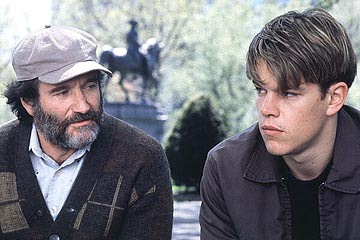
Goodwill Hunting


I just saw the movie for the first time (I know I'm a little late on that), and yes, I am aware that it is "Good Will Hunting", but I'm sure they meant to say something in the title more than something about the character Will Hunting himself. Maybe they were saying something like Will was hunting for "goodwill", for someone who would truly love him and speak directly to him and not use him, or something like that. Maybe.

But there were a couple things that struck me after having finally watched the movie. The first was the character of Sean Maguire, played by Robin Williams. Out of all the other "shrinks", he was the only one to engage Will, to share of his own life, to genuinely want to know Will and help him, and to be vulnerable himself.

I went to a conference in Colorado this past week where the president of Campus Crusade for Christ, Steve Douglass, shared a video monologue from a woman who was sort of speaking on behalf of my generation, or at least a significant portion of it, to the generation before. One of her main admonitions was for my parents' generation to share their lives with us. "We're disillusioned and skeptical and hurting and don't expect much else from life, but we desparately want more...we need more," she said. "We don't want a bunch of simple answers, but we desparately need you to walk with us, because you have been here before, you do know what it's like. We do need your help."

There was a scene like this in Good Will Hunting where, after Will has torn into Sean about his painting and his wife and all that, and Sean takes him out to the park the next week for their next session. Sean goes on to till Will that his comments the previous week kept him up most of the night until he realized that Will was just a kid and didn't know anything about having a wife, fighting in a war, etc. Here's the quote:

Sean: So if I asked you about art, you'd probably give me the skinny on every art book ever written. Michelangelo, you know a lot about him. Life's work, political aspirations, him and the pope, sexual orientations, the whole works, right? But I'll bet you can't tell me what it smells like in the Sistine Chapel. You've never actually stood there and looked up at that beautiful ceiling; seen that. If I ask you about women, you'd probably give me a syllabus about your personal favorites. You may have even been laid a few times. But you can't tell me what it feels like to wake up next to a woman and feel truly happy. You're a tough kid. And I'd ask you about war, you'd probably throw Shakespeare at me, right, "once more unto the breach dear friends." But you've never been near one. You've never held your best friend's head in your lap, watch him gasp his last breath looking to you for help. I'd ask you about love, you'd probably quote me a sonnet. But you've never looked at a woman and been totally vulnerable. Known someone that could level you with her eyes, feeling like God put an angel on earth just for you. Who could rescue you from the depths of hell. And you wouldn't know what it's like to be her angel, to have that love for her, be there forever, through anything, through cancer. And you wouldn't know about sleeping sitting up in the hospital room for two months, holding her hand, because the doctors could see in your eyes, that the terms "visiting hours" don't apply to you. You don't know about real loss, 'cause it only occurs when you've loved something more than you love yourself. And I doubt you've ever dared to love anybody that much. And look at you... I don't see an intelligent, confident man... I see a cocky, scared s***less kid. But you're a genius Will. No one denies that. No one could possibly understand the depths of you. But you presume to know everything about me because you saw a painting of mine, and you ripped my f*** life apart. You're an orphan right? [Will nods] Sean: You think I know the first thing about how hard your life has been, how you feel, who you are, because I read Oliver Twist? Does that encapsulate you? Personally... I don't give a s*** about all that, because you know what, I can't learn anything from you, I can't read in some f*** book. Unless you want to talk about you, who you are. Then I'm fascinated. I'm in. But you don't want to do that do you sport? You're terrified of what you might say. Your move, chief.

At the climax of the movie, Sean shows Will his file from the judge with all the info about his abuse as he grew up. Will asks Sean if he knew about that sort of thing. Sean says, "twenty five years of counseling, I've seen a lot of terrible stuff." "But have you ever seen that before," replied Will. "Me personally?... Yeah, my father was a violent acholic..." With that, Will knew that Sean knew what it was like. Sean then turned to him and said, "You know, it's not your fault." Will shakes his head, smiles a little and says, "Yeah, I know". Sean just repeats it with the same repsonse about five times before Will starts to change. Sean just keeps saying "it's not your fault," and Will finally begins to break down and say "Don't f*** with me." Finally, the walls are down and real healing can take place. Will weeps.

When thinking about sharing the Gospel or discipling, I wonder how many times it takes for those walls to come down. I wonder what kind relationship needs to be established before that's even a possibility. I wonder how many of my walls need to come down before I expect that anyone else's would. I wonder how many times I need to hear Jesus say "I love you. I died for you. Trust Me." before I would really believe that. Not just smile, shake my head and say, "yeah, I know," but let that punch a hole in my hard heart and cause me to weep...and believe.