Some thoughts on some quotes from Faith Thinking, by Trevor Hart, pp. 92-95.
Although the "ideal of truth as absolute certainty, knowledge as a subjugation of reality by the mind, and true statements as a direct and exhaustive mirroring of reality in propositional form" is an ideal which cannot be attained, "least of all where God is concerned, ...knowledge does not need to be absolutely certain nor (do) statements (need to be) precise verbal representations in order for there to be true knowledge and speech which bears appropriately upon the world."
For all the science folks out there, I would put it like this: at the beginning of college you learn certain equations and models for evaluating things that happen in the world around you, but these equations and models on approximate an actual situation. Towards the end of college your equations and models become more sophisticated, with more variables, constants, coefficients, and even more sophisticated approximations, but you're still approximating to a certain extent. That's why there are safety factors in engineering, to provide buffer for all the things that your approximations might have misjudged.
Now, just because a scientist or engineer can only really just refine and reshape all these approximate models and equations doesn't mean that the effort is pointless and better left to the backyard mechanic who finds a way to make it work for himself and his situation. There are discoverable reasons he is able to "make it work," and the pursuits of those reasons are worthwhile, and even authoritative to a certain extent, even if they are only approximate.
The references outside the system of Christian theology are "the very thing(s) with which Christian theology begins and ends: namely the claim that an extra-systematic reality is indeed to be known here; not on the basis of human endeavor and self-transcendence alone or as such, but because he makes himself know in particular ways, times and places. The claim, in other words, that God has revealed himself. Such a claim may well be impossible to prove or to demonstrate in 'public' fashion, but it furnishes the very starting point for theological activity as a passionate, committed quest for further understanding and truth. . . For if God has indeed spoken or acted in such a way as to give himself to be known here, then to withhold or suspend fiduciary commitment to this story as public truth is to fail in one's moral responsibility in the face of reality."
It is ridiculous and foolish to deal with the system of Christian theology as if it had no meaningful references or sources outside its collections of propositions and doctrines, as if it were just a "value meal" among "value meals" with no connection to the cow or potato or food distribution warehouse from which it came. The system of Christian theology claims a source outside itself, rooted in the public and observable, even if it still open to interpretation in public. To ignore Christian theology's claim on reality while seeking to do Christian theology is not to do Christian theology at all. It is as if, stranded in the wilderness, one said to one's family "Well, we believe that we are stranded in the wilderness so let's use these resources we have to make it out" while saying to and of others, "They may not believe they're stranded in the wilderness, and they could be right, so we'll not bother them too much. I'm sure they'll work things out as what's best for them, and maybe we can learn something from them too." It may still be a theology of some sort, but not of the Christian sort.
Monday, February 12, 2007

Monday, February 05, 2007
ugh...this one is hard
Here's a Bible quiz that Alastair Roberts created after he conquered all the others. It's quite challenging. How do you fair?
You rank 53% on the biblical comprehension scale.
Good work. You obviously know your Bible well. However, there remains plenty of room for improvement. Close attention to the details of Scripture can result in great rewards over time. Perhaps a more focused Bible study plan would help you improve your level of biblical comprehension.
How Well Do You Know Your Bible?
Quizzes for MySpace
Sunday, February 04, 2007
"The Bible says it, and that settles it!"

So my friend and I were talking about the meaning and nature of language over a bowl of red curry today, and I said something to the effect of, "It makes me nervous sometimes when I hear people pick up their Bible, read a short story or a couple of verses, and matter-of-factly say 'The Bible says ____, and that settles it.' We're so far away from the cultural context of the New Testament at the least, not to mention the range of cultural settings in the Old Testament, that if it weren't for the sovereign and active work of the Holy Spirit and all the elements of common grace, it would be very difficult for the Bible to mean anything to us at all."
As I was cleaning my room up a little bit, and even as I am writing this, I think that I had overplayed in my mind the enormity of the influence of such a cultural divide and downplayed the extent of the Spirit's work and of elements of common grace in any and every age and culture. The Spirit has in fact been at work both in the academy and on the streets and in the jungles to enlighten and to teach, to open up the Scriptures as Jesus did on the road to Emmaus, and to cross cultural divides as Paul did on Mars Hill. Truth is not out of reach for anyone to receive and believe, even though our hands are not so big as to hold it all at once.
Friday, February 02, 2007
Jesus loves porn stars, just in case you were inclined to think otherwise...
 Several friends of mine have been telling me about these guys who go to porn conventions and tell people that "Jesus loves porn stars." So, when I saw that they would be on ABC Nightline with Martin Bashir, I put down the remote paid attention for a few minutes.
Basically, XXXChurch.com started as a web resource for Christians struggling with pornography, but changed courses a bit when the founders, Craig Gross and JR Mahon, decided to set up a booth (not unlike my organizations "FSK tables") where they handed out New Testaments with "Jesus loves porn stars" on the cover.
The Nightline interview seemed to focus heavily on their impact, or lack thereof, on the porn industry, to which they replied that they weren't trying to stop the porn industry, just inform and educate. By which they meant, I assume, to inform and educate as to the destructive capacities of pornography and the restorative and redemptive power of the Gospel. Mahon and Gross weren't as articulate and insightful as I hoped they would be (but would I be on national television?). But, their actions, of course, were the most telling, which is exactly what they would want, I'm sure. They stand in good company with others that have dined with prostitutes and tax collectors...
While they had some great things to say about pornography and the sex industry, their most powerful confrontation came not in the parking lot of the adult video store but in the front lawn of the local church. In a clear and passionate prophetic voice they said,
"The church is good at sitting in their pews and judging the world, but if you really want to change the world, get off your butts, get out into the community, and do something for a fellow human being. If you're not doing that, and you're just sitting in your pews raising your hands and praising God, then you're not really doing even that." (my rough paraphrase)
It reminded me of something else someone said along the same lines:
If you really fulfill the royal law according to the Scripture, "You shall love your neighbor as yourself," you are doing well. But if you show partiality, you are committing sin and are convicted by the law as transgressors. For whoever keeps the whole law but fails in one point has become accountable for all of it. For he who said, "Do not commit adultery," also said, "Do not murder." If you do not commit adultery but do murder, you have become a transgressor of the law. So speak and so act as those who are to be judged under the law of liberty. For judgment is without mercy to one who has shown no mercy. Mercy triumphs over judgment. - James, Jesus' brother, from James 2:8-13
And from Jesus' closest disciple John,
By this we know love, that he laid down his life for us, and we ought to lay down our lives for the brothers. But if anyone has the world's goods and sees his brother in need, yet closes his heart against him, how does God's love abide in him? Little children, let us not love in word or talk but in deed and in truth. - 1 John 3:16-18
If you want the scoop from Nightline, check it out here:
ABC News: The Porn Pastors: XXXChurch.com
If you do anything with this information, pray for these guys and all the ones that labor with them. Pray that God would use them and their living out of and proclamation of the Gospel to bring real transformation and freedom and that He would protect them from temptation. They are right in the middle of all sorts of spiritual battles. And then pray for yourselves, that the Spirit of Jesus would show you how you might grow in faithfulness, purity, and how to love "in deed and in truth."
Wednesday, January 24, 2007
some words on The Word

Excerpts from the Edwardian Homilies of the English Reformation as issued by Edward VI of England and composed by Thomas Cranmer, Archbishop of Canterbury, 1547. Cranmer was martyred 9 years later after the Pope regained control of England.
Taken from Creeds of the Churches, edited by John Leith, gifted to me by my friend Kat as bathroom reading material... :)
A Fruitful Exhoration to the Reading and Knowledge of Holy Scripture
Unto a Christian man (or woman) there can be nothing either more necessary or profitable, than the knowledge of holy scripture, forasmuch as in it is contained God's true word, setting forth his glory, and also man's duty. And there is no truth nor doctrine necessary for our justification and everlasting salvation, but that is, or may be drawn out of that fountain and well of truth.
Therefore as many as be sesirous to enter into the right and perfect way unto God, must apply thier minds to know holy scritpure; without the which, they can neither sufficiently know God and his will, neither their office and duty. And as drink is pleasant to them that be dry, and meat to them that be hungry; so is the reading, heargin, searching, and studying of holy scripture, to them that be desirous to know God, or themselves, and to do his will.
And their stomachs only do loathe and abhor the heavenly knowledge and food of God's word, that be so drowned in worldly vanities, that they neither savour God, nor any godliness: for that is the cause why they desire such vanities, rather than the true knowledge of God.
And in reading of God's word, he most profiteth not always that is most ready in turning of the book, or in saying of it without the book; but he that is most turned into it, that is most inspiried with the Holy Ghost, most in his heart and life altered and changed into that thing which he readeth; he that is daily less and less proud, less wrathful, less covetous, and less desirous of worldly and vain pleasures; he that daily (forsaking his old vicious life) increaseth in virtue more and more.
And, to be short, there is nothing that more maintaineth godliness of the mind, and driveth away ungodliness, than doth the continual reading or hearing of God's word, if it be joined with a godly mind, and a good affection to know and follow God's will. For without a single eye, pure intent, and good mind, nothing is allowed for good before God. And, on the other side, nothing more darkeneth Christ and the glory of God, nor bringeth in more blindness and all kinds of vices, than doth the ignorance of God's word.
Wednesday, January 10, 2007
2+2=Jesus

I'm working it out.
I don't know what I'm doing, but I'm working it out.
You see, some things are really hot right now. Social justice, redemptive history, church-planting movements, the "kingdom". It's not a time for specialists; there's too much to think about, to do. It's not a time for generalists either, one wouldn't even know where to begin.
People keep telling me that it's all about Jesus. I believe them, I do. 'Cause it is, you know, all about Jesus. I mean, he said it himself, "This is eternal life, that they would know you, the only true God, and Jesus Christ whom you have sent." And, whatever he meant by "knowing" and "eternal life", it certainly seems like He takes center stage and first place and number one and everything up to those.
So, I'm working out. Certainly Jesus didn't mean that it's just him and me and no one else or nothing else, but, shoot, what the heck did he mean?
I mean, I was thinking: What if knowing involves doing? and thinking? and speaking? and working? and resting? and worshiping? Didn't Jesus say, "He who loves me will keep my commandments, and I will show myself to him, and the Father and I will come to him and make our home with him"?
To borrow a phrase from Brother Andrew, "practising the presence of God" seems to involve some external activity as well as internal. John said that when Jesus returns we will become like Him, "because we will see him just as he is." With our eyes, the ones in our head, I expect. Kinda like when you see something indescribably beautiful or terrifyingly hideous, you don't recover from that too quickly. But when we finally see Jesus, with the eyes in our head, then we will be changed, permanently. Not just on the inside, but all over and all throughout, forever.
So, what if we know Jesus through our hands too? I mean, not perfectly right now of course, but a little bit, like when we see a sunset and worship its maker, or when we listen to Sufjan Steven's rendition of Amazing Grace and worship the one who makes grace sound so amazingly sweet. I think that our hands can be conduits of knowing too. Just ask Helen Keller. Or rather, touch her hands.
It is the Spirit who moves in hands and feet and words and images to bring the mind to apprehend and the heart to engage the mind and heart and spirit of Christ.
Would I think Jesus' thoughts after him? Would I work his works? Would I pray his prayers? Would I speak his words? Would I then know him?
Theology proper is the study of God, who he is, what he is, why he is, where he is, how he is. You get the picture. But is that all you get? Is that all I get? Is God like history? or math? or biology? or music? or art? or a good story? Can I know God without knowing anything about him? Can I know anything about God without knowing Him?
The world is theo-centric, and in the center are two pierced hands and two pierced feet and a bleeding side. Put your feet on his. Put your hands to his. Hide yourself in his side and step out into his world with a calculator. He is the sum of all things.
"Worship is the gathering up the praises of all creation, making them articulate, and presenting them to God." - N. T. Wright
Grab your baskets.
Monday, December 25, 2006
it came upon a midnight clear
Isaiah 9.2–7; Luke 2.1–20
a sermon at the Midnight Eucharist, Christmas Eve 2006
by the Bishop of Durham, Dr N. T. Wright
The following is from the Christmas hymn, "It Came Upon a Midnight Clear", but with a few of the lines changed a bit in order to more accurately represent the heart of the prophets and the meaning of Christmas, which, as Bishop Tom Wright said this is Christmas eve, is a "summons to us, as it was to his first followers, to sign on under his authority, to celebrate the birth of the Wonderful Counsellor, the Mighty God, the Everlasting Father, the Prince of Peace, and to work under that authority for the growth of his promised kingdom of endless peace, of justice and righteousness."
For lo, the days are hastening on,
-Edmund Sears and N.T. Wright
Thursday, December 21, 2006
A song and a Prayer
You are so high among the highest, and I am low among the lowest, a mean thing. You never go away from us. Yet we have difficulty in returning to you. Come Lord, stir us up and call us back, kindle and seize us, be our fire and our sweetness. Let us love, let us run (to you).
-St. Augustine
Since from His bounty I receive
Such proofs of love divine
Had I a thousand hearts to give
Lord, they should all be Thine
A thousand men could not compose
A worthy song to bring
Yet Your love is a melody
Our hearts can’t help but sing!
-To Christ the Lord Let Every Tongue,
Samuel Stennet and Laura Taylor
-St. Augustine
Since from His bounty I receive
Such proofs of love divine
Had I a thousand hearts to give
Lord, they should all be Thine
A thousand men could not compose
A worthy song to bring
Yet Your love is a melody
Our hearts can’t help but sing!
-To Christ the Lord Let Every Tongue,
Samuel Stennet and Laura Taylor
Sunday, December 17, 2006
who are you?
 You scored as Karl Barth. The daddy of 20th Century theology. You perceive liberal theology to be a disaster and so you insist that the revelation of Christ, not human experience, should be the starting point for all theology. You scored as Karl Barth. The daddy of 20th Century theology. You perceive liberal theology to be a disaster and so you insist that the revelation of Christ, not human experience, should be the starting point for all theology. |
Which theologian are you? created with QuizFarm.com |
Saturday, December 16, 2006
so, what do you do?


 Here's an article from the New York Times about the brew-ha-ha that's going on with the American Episcopal church. With the ordination of the first openly gay priest a few years back, and the following installment of the first woman bishop of the entire Episcopal church in America, many of the more conservative churches and dioceses have felt jilted, and now they are leaving.
Not too long ago, several other members of the Anglican communion in some of the poorer parts of the world including Bolivia, Rwanda, and Nigeria got together to send missionaries over to help save the day. Now, many of the conservative Episcopal churches and dioceses are leaving the Episcopal church and joining up with these foreign branches of the Anglican communion because of irreconcilable differences.
 So, what do you do? The Anglican communion has historically been very broad as far as the scope of doctrine professed, but for many it seems that now a line has been crossed. For me, of course, I think a line has definitely been crossed, at least with regards to homosexuality, if not also with the ordination of women. Is that cause for secession? What is cause for the breaking of fellowship? From what Paul the apostle said, and maybe Jesus too, it seems to be unrepenant sin is cause for breaking fellowship. But of course, that begs the questions, what kind of sin, who defines it, is it possible to really let the Scripture settle the issue, etc. I think so. I want to believe that it is, or we might as well just go in any old direction we want.
Several years ago J.I. Packer commented in Christianity Today about why he walked out of the meeting in which a decision was made to bless same-sex unions by saying that
"this decision, taken in its context, falsifies the gospel of Christ, abandons the authority of Scripture, jeopardizes the salvation of fellow human beings, and betrays the church in its God-appointed role as the bastion and bulwark of divine truth. My primary authority is a Bible writer named Paul. For many decades now, I have asked myself at every turn of my theological road: Would Paul be with me in this? What would he say if he were in my shoes? I have never dared to offer a view on anything that I did not have good reason to think he would endorse."
It's not an uncomplicated situation, and it won't be a quick fix, but someone somewhere at some point in time has to draw the line. And this time it might just be time for a change. I pray that it would not include division, but if it must, then let it be for the truth of Christ and the Scriptures and the glory of God, the only foundation for Christian love.
Thursday, December 14, 2006
don't just explain it...
 "Ironically, an estimated 90% of the world's Chirstian workers presenting the gospel use highly literate communication styles. They use the printed page or expositional, analytical and logical presentations of God's word. This makes it difficult, if not impossible, for oral learners to hear and understand the message and communicate it to others."
But, that's exactly part of the problem, that this understanding of "sharing the Gospel" is rooted in where I'm from. I am the product of all that I have inherited culturally, and part of that is a highly literate, abstract-conceptual form of thinking that looks for and responds to "logical presentations." But not everyone is like this, really, most people in the world are not like this, and even for those that are, it's only a percentage of their whole preferred learning methods. Literacy and literate thinking is not the norm, orality and oral communication is.
"All societies, including those having a highly literate segment, have oral comunication at their core. Oral communication is the basic function on which writing and literacy is based. When literacy persists in a culture for generations, it begins to change the way people think, act and communicate...These members of a literate society then tend to communicate the gospel in the literate style that speaks to them."
So, is the goal to make everyone literate like those of us who are? Is that the only way that they can understand the Gospel? Reason and experience tell us otherwise. Just as Paul and the first centuries of Christians translated the Gospel into the Greek culture around them, so we must work to translate the Gospel into the cultures that we go to or find ourselves in. And this is more than just using different words or languages; it involves entirely different forms of communication including "stories, proverbs, poetry, chants, music, dances, ceremonies and rites of passage."
Wednesday, December 06, 2006
a new effort

I was saved from a Hindu family in 1995 through a cross-cultural missionary. I had a desire to learn more about the word of God and I shared this with the missionary. The missionary sent me to Bible College in 1996... I started sharing the good news in the way as I learnt in the Bible College.. To my surprise my people were not able to understand my message. A few people accepted the Lord after much labour...there were little results.
In 1999 I attended a seminar where I learnt how to communicate the gospel using different oral methods. I understood the problem in my communication as I was mostly using a lecture method with printed books, which I learnt in the Bible school. After the seminar I went to the village but this time I changed my way of communication. I started using a storytelling method in my native language. I used gospel songs and the traditional music of my people. This time the people in the villages began to understand the gospel in a better way. As a result of it people began to come in large numbers. Many accepted Christ and took baptism. There was on church with few baptized members in 1999...now in 2004, in six years we have 75 churches with 1350 baptized members and 100 more people are ready for baptism.
This is just one of many stories from all over the world that have been surfacing for the past decade (at least) concerning a paradigm shift in how people are introduced to God, Jesus, and Christianity and subsequently discipled in the faith. For the next few weeks I will be blogging about this in response to the book, Making Disciples of Oral Learners, published by the Lausanne Committee for World Evangelization, originally published as a paper for their 2004 forum in Thailand.
Of course, at face value, you may be wondering what this has to do with evangelism in the United States. I mean, we can all read and write, right? Well, yes, and no, and we'll discuss that as we go. I'll just say for now that our ability to read and write (or lack thereof) isn't as fundamental as we'd like to think it is, and that even though we're a highly literate culture, most of us still learn best through oral methods (including pictures and movies), and, it is story and stories that shape our worldview more than anything else.
So, if you'd like to check the book out for yourself, please do. You can read it for free online! And, until next time, read a good story or two...
Wednesday, November 22, 2006
Goodwill Hunting
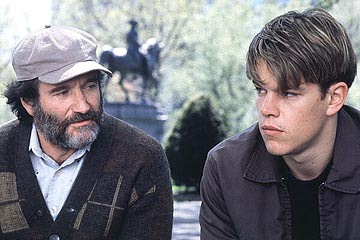
I just saw the movie for the first time (I know I'm a little late on that), and yes, I am aware that it is "Good Will Hunting", but I'm sure they meant to say something in the title more than something about the character Will Hunting himself. Maybe they were saying something like Will was hunting for "goodwill", for someone who would truly love him and speak directly to him and not use him, or something like that. Maybe.
But there were a couple things that struck me after having finally watched the movie. The first was the character of Sean Maguire, played by Robin Williams. Out of all the other "shrinks", he was the only one to engage Will, to share of his own life, to genuinely want to know Will and help him, and to be vulnerable himself.
I went to a conference in Colorado this past week where the president of Campus Crusade for Christ, Steve Douglass, shared a video monologue from a woman who was sort of speaking on behalf of my generation, or at least a significant portion of it, to the generation before. One of her main admonitions was for my parents' generation to share their lives with us. "We're disillusioned and skeptical and hurting and don't expect much else from life, but we desparately want more...we need more," she said. "We don't want a bunch of simple answers, but we desparately need you to walk with us, because you have been here before, you do know what it's like. We do need your help."
There was a scene like this in Good Will Hunting where, after Will has torn into Sean about his painting and his wife and all that, and Sean takes him out to the park the next week for their next session. Sean goes on to till Will that his comments the previous week kept him up most of the night until he realized that Will was just a kid and didn't know anything about having a wife, fighting in a war, etc. Here's the quote:
Sean: So if I asked you about art, you'd probably give me the skinny on every art book ever written. Michelangelo, you know a lot about him. Life's work, political aspirations, him and the pope, sexual orientations, the whole works, right? But I'll bet you can't tell me what it smells like in the Sistine Chapel. You've never actually stood there and looked up at that beautiful ceiling; seen that. If I ask you about women, you'd probably give me a syllabus about your personal favorites. You may have even been laid a few times. But you can't tell me what it feels like to wake up next to a woman and feel truly happy. You're a tough kid. And I'd ask you about war, you'd probably throw Shakespeare at me, right, "once more unto the breach dear friends." But you've never been near one. You've never held your best friend's head in your lap, watch him gasp his last breath looking to you for help. I'd ask you about love, you'd probably quote me a sonnet. But you've never looked at a woman and been totally vulnerable. Known someone that could level you with her eyes, feeling like God put an angel on earth just for you. Who could rescue you from the depths of hell. And you wouldn't know what it's like to be her angel, to have that love for her, be there forever, through anything, through cancer. And you wouldn't know about sleeping sitting up in the hospital room for two months, holding her hand, because the doctors could see in your eyes, that the terms "visiting hours" don't apply to you. You don't know about real loss, 'cause it only occurs when you've loved something more than you love yourself. And I doubt you've ever dared to love anybody that much. And look at you... I don't see an intelligent, confident man... I see a cocky, scared s***less kid. But you're a genius Will. No one denies that. No one could possibly understand the depths of you. But you presume to know everything about me because you saw a painting of mine, and you ripped my f*** life apart. You're an orphan right? [Will nods] Sean: You think I know the first thing about how hard your life has been, how you feel, who you are, because I read Oliver Twist? Does that encapsulate you? Personally... I don't give a s*** about all that, because you know what, I can't learn anything from you, I can't read in some f*** book. Unless you want to talk about you, who you are. Then I'm fascinated. I'm in. But you don't want to do that do you sport? You're terrified of what you might say. Your move, chief.
At the climax of the movie, Sean shows Will his file from the judge with all the info about his abuse as he grew up. Will asks Sean if he knew about that sort of thing. Sean says, "twenty five years of counseling, I've seen a lot of terrible stuff." "But have you ever seen that before," replied Will. "Me personally?... Yeah, my father was a violent acholic..." With that, Will knew that Sean knew what it was like. Sean then turned to him and said, "You know, it's not your fault." Will shakes his head, smiles a little and says, "Yeah, I know". Sean just repeats it with the same repsonse about five times before Will starts to change. Sean just keeps saying "it's not your fault," and Will finally begins to break down and say "Don't f*** with me." Finally, the walls are down and real healing can take place. Will weeps.
When thinking about sharing the Gospel or discipling, I wonder how many times it takes for those walls to come down. I wonder what kind relationship needs to be established before that's even a possibility. I wonder how many of my walls need to come down before I expect that anyone else's would. I wonder how many times I need to hear Jesus say "I love you. I died for you. Trust Me." before I would really believe that. Not just smile, shake my head and say, "yeah, I know," but let that punch a hole in my hard heart and cause me to weep...and believe.
Tuesday, November 07, 2006
So, what IS the professor thinking...?
"A common perception of the college or university professor is that she or he is an atheist who rejects religion in favor of science or critical inquiry. "
According to a "working paper" (posted on Scot McKnight's blog, JesusCreed) entitled "HOW RELIGIOUS ARE AMERICA’S COLLEGE AND UNIVERSITY PROFESSORS?", researchers Neil Gross (Harvard University) and Solon Simmons (George Mason University) discovered that only 23.4 percent of university professors claimed to be agnostic or athiest. Now, this is much higher than that of the general US population and, even more appropriately, the college educated, "with about 11.2 percent of those with four years of college or more falling into the ranks of atheists and agnostics." So, while there is a marked difference in academia, "atheists and agnostics are in the minority among professors as a whole."
Here are some of the findings of the research:
1. Professors teaching in religiously-affiliated colleges and universities are more likely to be
believers (non-athiest/agnostic). (As expected...)
2. Professors at elite doctoral universities are much less religious than professors teaching in other kinds of institutions. (No surprise here either...)
3. Atheists and agnostics are more common in some disciplines than others.
Psychology and biology - 61 percent.
Mechanical engineering - 50 percent (shoot! come on fellow ME's!)
Economics, political science, and computer science - 4o percent
There are several other aspects to these findings and many other findings as well in the paper, which I encourage you to check out if you have the time.
So, I just thought this is a helpful piece to help us to be aware of what is probably going on in the professor's head, whether we agree with it or not. The situation is not as extreme as most evangelical Christians might first think, but, especially at elite doctoral universities you will run into many who are avowedly athiest/agnostic and probably more vocal about it, to boot.
Please pray that Jesus Christ, who became for us the wisdom of God, would redeem the dark places of the universities and bring light and life to the professors and all that they "profess".
According to a "working paper" (posted on Scot McKnight's blog, JesusCreed) entitled "HOW RELIGIOUS ARE AMERICA’S COLLEGE AND UNIVERSITY PROFESSORS?", researchers Neil Gross (Harvard University) and Solon Simmons (George Mason University) discovered that only 23.4 percent of university professors claimed to be agnostic or athiest. Now, this is much higher than that of the general US population and, even more appropriately, the college educated, "with about 11.2 percent of those with four years of college or more falling into the ranks of atheists and agnostics." So, while there is a marked difference in academia, "atheists and agnostics are in the minority among professors as a whole."
Here are some of the findings of the research:
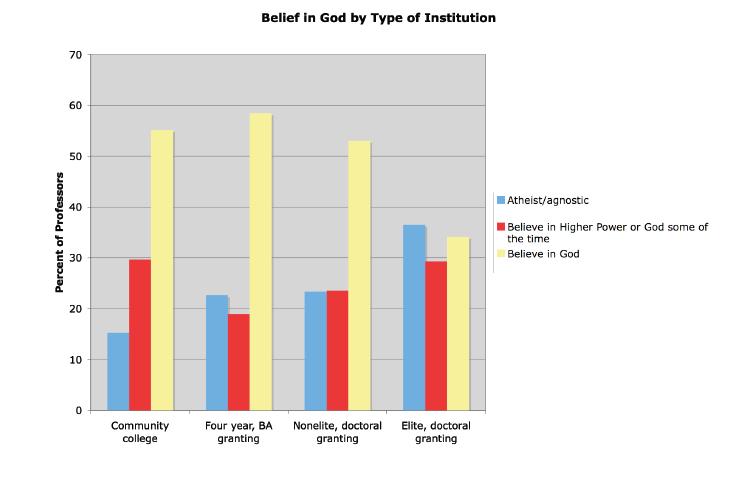
1. Professors teaching in religiously-affiliated colleges and universities are more likely to be
believers (non-athiest/agnostic). (As expected...)
2. Professors at elite doctoral universities are much less religious than professors teaching in other kinds of institutions. (No surprise here either...)
3. Atheists and agnostics are more common in some disciplines than others.
Psychology and biology - 61 percent.
Mechanical engineering - 50 percent (shoot! come on fellow ME's!)
Economics, political science, and computer science - 4o percent
There are several other aspects to these findings and many other findings as well in the paper, which I encourage you to check out if you have the time.
So, I just thought this is a helpful piece to help us to be aware of what is probably going on in the professor's head, whether we agree with it or not. The situation is not as extreme as most evangelical Christians might first think, but, especially at elite doctoral universities you will run into many who are avowedly athiest/agnostic and probably more vocal about it, to boot.
Please pray that Jesus Christ, who became for us the wisdom of God, would redeem the dark places of the universities and bring light and life to the professors and all that they "profess".
Saturday, October 28, 2006
Oklahoma Catalytic Fall Retreat 2006: Sent Video
A little slideshow video tour of the past year-ish of Oklahoma Catalytic students and staff sent throughout the world with the Gospel of Jesus Christ.
The audio is "Take to the World", written by Aaron Tate, sung by Derek Webb and Dan Haseltine, from Derek's album, "She Must and Shall Go Free."
The audio is "Take to the World", written by Aaron Tate, sung by Derek Webb and Dan Haseltine, from Derek's album, "She Must and Shall Go Free."
Tuesday, October 17, 2006
para-church phase out response
This is a response to this blog entry about a proposal to phase out the campus ministry of CCC. Neither the original blog nor my response are the opinions of CCC or the expression of anything bad or mean or disrespectful towards the past, present, or future of CCC. It's just some thoughts, theories, and desires for how things might be, hopefully in a way that is faithful to the heart of Jesus and the teaching of the New Testament.
Here's the original blog post: Parachurch Phase-out
Here's my response:
Kristie, you are thinking in a very good direction. Along with Melinda, I am also on staff in the Red River Region. I was involved with Crusade in limited fashion during college through my church's partnership with WSN and some relationships with staff and cru folk. I was on STINT for two years in East Asia with a team made up only from my church, and have since returned to be part of the Oklahoma Catalytic team.
Since my long term involvement with Crusade happened as a result of my church's partnership with WSN, I have always felt the need for a closer relationship between the campus ministry and the local church. So, like I said, you're thinking in a very good direction.
It's always precarious to make sweeping generalizations about things that are beyond one's ability to comprehensively evaluate, but I'm going to try anyway (I guess I just did...). There's an unhealthy split between the campus ministry and the local church. I say that because most Crusade students I know have very limited connection to any local church, if they have any at all. Most only attend a Sunday service weekly at best. I keep hearing from students the line that "In crusade I get fellowship, mission, Bible teaching, worship. Why should I go to church? Isn't that what it's for?"
Well, it seems to me that many Crusade students, and others probably, don't know what church is, and we may in fact need better definitions. I think most everyone realizes that the church is not the building; it is the people of God. But, if that is it, then when we plant movements, are we not then planting churches?
Recently at a Growing and Planting Movements conference, I asked this question during a Q&A time, "What's the difference between building movements and planting churches?" The answer was several minutes of silence. I think this was in part due to the fact that people using the language of building movements is new and very similar to the rapidly mulitplying church planting movements going on around the world. (We were even given the IMB's guide to planting Rapidly Multiplying Church Planting movements at our regional time at this last CSU conference.) It seems that this is a question that we are still working on.
From what one of the national team said, Campus Crusade for Christ as an organization has had a really good track record in working with local churches and denominations. Just read _Come Help Change the World_ and you can see that, but the campus ministry has not always been as successful in partnering with local churches and denominations. There are pockets where this is not the case, but until recently in Catalytic, it has not been something we have pursued with much conviction. I pray this continues to change.
In honor of Justin Timberlake with respect to para-church ministry, I would like to bring "para" back. Parachurch was meant to come along side the local church to strengthen it and reach out in ways that it couldn't (and many times wouldn't). But when it comes to campus ministry, it is not good enough simply that "we do our thing, they do theirs, and hopefully some crossover will happen when students graduate and join a church or someone from the church joins staff or supports us."
Like you Kristie, I would love to see the day when we work ourselves out of a job when it comes to doing all of the evangelism and discipleship on campus. If we are really going to reach all of the students of the world, it's going to happen through the ministry of local churches who stay there year after year and continue to train and disciple college students in large numbers as they pass through college. It will take a movement of "volunteers", plain and simple. Churches in their very nature are much more stable than campus ministries and much less dependent on the coming and going student leaders.
And I say this much not even having mentioned the question "what is church?" If a proper, God-ordained, apostolically proclaimed visible church body includes things like baptism, eucharist, elders, deacons, discipline, and social justice then we've got a problem when students feel that Crusade is their church because the worship, evangelize, fellowship, and learn the Word in that community. Because, in reality, many campus ministries (to overgeneralize again) function like churches on campus with staff as elders, student leaders as deacons, focusing on evangelism and discipleship without much concern for social justice and no baptisms or eucharist. (My pastor even remarked to me one day that he thought it would be great if orgs like CCC started baptizing and serving communion...) If all that students of a campus ministry see church for is getting baptized and occasional sunday mornings with communion if they come on the right day, then we have done a terrible injustice to them and to the church, and we have not set them up with a good ecclesiology to live from before and after they graduate.
I do think the catalytic style is heading in the right direction on this, but it must keep adapting. Reproducing staffed campus models on unstaffed campuses is not what we should aim for. This is, I believe, what Movements Everywhere and Mulitple Movements are all about, and without local church involvement and ownership, it will not succeed. (Unless of course God decides to reject the local church in this and work outside of it, but I don't think that is the case, and we would still continue to run into the same problems down the road and find that we would need to start planting churches anyway.) The campus ministry is not in the business of planting churches and shouldn't be, the freshman to senior cycle is too fast and volatile. But, if we do not work closely with local churches in building movements everywhere in every group on campus, then we will be planting churches, lopsided and unhealthy ones at that. And I don't know anyone in the campus ministry that wants to start planting CCC churches.
So, all that to say I like your proposal, but I would tweak a few things. I do think it will be necessary for Crusade staff to remain intimately involved on campus, but in a different way. My vision of the staff of the future would be that a majority of the campus staff would be catalytic and forerunners. The primary goals of the staff would be to network and build partnerships with local churches to reach campuses near them and to train church volunteers and student leaders in building and sustaining mulitplying movements of evangelism and discipleship. Bible studies and weekly meetings and such for the different movements on campus would be the responsibility of the students under the guidance and support of church volunteers and in line with the vision of CCC as communicated through the staff.
Staff would be the ones that keep expanding things, taking on new campuses and partnerships, both locally and with WSN, and giving vision and training for the volunteers and student leaders. There will certainly be room for continued one-to-one discipleship with students (because the staff still need to be intimately connected to the student world), but it will be limited.
One area in which I see great potential in this is in a CCC strategy called No Boundaries (www.nobounds.org) in which staff seek to plant churches in hard to reach countries through college students. Students who have been involved in campus ministry within the context of a chruch would be very prepared to enter into this kind of effort.
So, that's quite a comment, I know. I always seem to post long comments... But, please take it as a complement to the thought-provokingness of your post. I hope this discussion continues and even moves up the chain, which I'm sure it has in some fashion already. We probably just don't know about it yet.
Here's the original blog post: Parachurch Phase-out
Here's my response:
Kristie, you are thinking in a very good direction. Along with Melinda, I am also on staff in the Red River Region. I was involved with Crusade in limited fashion during college through my church's partnership with WSN and some relationships with staff and cru folk. I was on STINT for two years in East Asia with a team made up only from my church, and have since returned to be part of the Oklahoma Catalytic team.
Since my long term involvement with Crusade happened as a result of my church's partnership with WSN, I have always felt the need for a closer relationship between the campus ministry and the local church. So, like I said, you're thinking in a very good direction.
It's always precarious to make sweeping generalizations about things that are beyond one's ability to comprehensively evaluate, but I'm going to try anyway (I guess I just did...). There's an unhealthy split between the campus ministry and the local church. I say that because most Crusade students I know have very limited connection to any local church, if they have any at all. Most only attend a Sunday service weekly at best. I keep hearing from students the line that "In crusade I get fellowship, mission, Bible teaching, worship. Why should I go to church? Isn't that what it's for?"
Well, it seems to me that many Crusade students, and others probably, don't know what church is, and we may in fact need better definitions. I think most everyone realizes that the church is not the building; it is the people of God. But, if that is it, then when we plant movements, are we not then planting churches?
Recently at a Growing and Planting Movements conference, I asked this question during a Q&A time, "What's the difference between building movements and planting churches?" The answer was several minutes of silence. I think this was in part due to the fact that people using the language of building movements is new and very similar to the rapidly mulitplying church planting movements going on around the world. (We were even given the IMB's guide to planting Rapidly Multiplying Church Planting movements at our regional time at this last CSU conference.) It seems that this is a question that we are still working on.
From what one of the national team said, Campus Crusade for Christ as an organization has had a really good track record in working with local churches and denominations. Just read _Come Help Change the World_ and you can see that, but the campus ministry has not always been as successful in partnering with local churches and denominations. There are pockets where this is not the case, but until recently in Catalytic, it has not been something we have pursued with much conviction. I pray this continues to change.
In honor of Justin Timberlake with respect to para-church ministry, I would like to bring "para" back. Parachurch was meant to come along side the local church to strengthen it and reach out in ways that it couldn't (and many times wouldn't). But when it comes to campus ministry, it is not good enough simply that "we do our thing, they do theirs, and hopefully some crossover will happen when students graduate and join a church or someone from the church joins staff or supports us."
Like you Kristie, I would love to see the day when we work ourselves out of a job when it comes to doing all of the evangelism and discipleship on campus. If we are really going to reach all of the students of the world, it's going to happen through the ministry of local churches who stay there year after year and continue to train and disciple college students in large numbers as they pass through college. It will take a movement of "volunteers", plain and simple. Churches in their very nature are much more stable than campus ministries and much less dependent on the coming and going student leaders.
And I say this much not even having mentioned the question "what is church?" If a proper, God-ordained, apostolically proclaimed visible church body includes things like baptism, eucharist, elders, deacons, discipline, and social justice then we've got a problem when students feel that Crusade is their church because the worship, evangelize, fellowship, and learn the Word in that community. Because, in reality, many campus ministries (to overgeneralize again) function like churches on campus with staff as elders, student leaders as deacons, focusing on evangelism and discipleship without much concern for social justice and no baptisms or eucharist. (My pastor even remarked to me one day that he thought it would be great if orgs like CCC started baptizing and serving communion...) If all that students of a campus ministry see church for is getting baptized and occasional sunday mornings with communion if they come on the right day, then we have done a terrible injustice to them and to the church, and we have not set them up with a good ecclesiology to live from before and after they graduate.
I do think the catalytic style is heading in the right direction on this, but it must keep adapting. Reproducing staffed campus models on unstaffed campuses is not what we should aim for. This is, I believe, what Movements Everywhere and Mulitple Movements are all about, and without local church involvement and ownership, it will not succeed. (Unless of course God decides to reject the local church in this and work outside of it, but I don't think that is the case, and we would still continue to run into the same problems down the road and find that we would need to start planting churches anyway.) The campus ministry is not in the business of planting churches and shouldn't be, the freshman to senior cycle is too fast and volatile. But, if we do not work closely with local churches in building movements everywhere in every group on campus, then we will be planting churches, lopsided and unhealthy ones at that. And I don't know anyone in the campus ministry that wants to start planting CCC churches.
So, all that to say I like your proposal, but I would tweak a few things. I do think it will be necessary for Crusade staff to remain intimately involved on campus, but in a different way. My vision of the staff of the future would be that a majority of the campus staff would be catalytic and forerunners. The primary goals of the staff would be to network and build partnerships with local churches to reach campuses near them and to train church volunteers and student leaders in building and sustaining mulitplying movements of evangelism and discipleship. Bible studies and weekly meetings and such for the different movements on campus would be the responsibility of the students under the guidance and support of church volunteers and in line with the vision of CCC as communicated through the staff.
Staff would be the ones that keep expanding things, taking on new campuses and partnerships, both locally and with WSN, and giving vision and training for the volunteers and student leaders. There will certainly be room for continued one-to-one discipleship with students (because the staff still need to be intimately connected to the student world), but it will be limited.
One area in which I see great potential in this is in a CCC strategy called No Boundaries (www.nobounds.org) in which staff seek to plant churches in hard to reach countries through college students. Students who have been involved in campus ministry within the context of a chruch would be very prepared to enter into this kind of effort.
So, that's quite a comment, I know. I always seem to post long comments... But, please take it as a complement to the thought-provokingness of your post. I hope this discussion continues and even moves up the chain, which I'm sure it has in some fashion already. We probably just don't know about it yet.
Sunday, October 08, 2006
agendas
I was talking to my friend Chris the other day about conversations with people wherein we discover that what seems to be one reason for a certain line of questioning or behavior actually turns out to be another and how that can be rather offensive and manipulative. It seems that in those situations, the issue is not so much that the person had a secret agenda behind their questions and behavior, but that it was a secret agenda.
There's a lot of fuss today made over people who have agendas behind their words and actions in everything from personal relationships to politics, philosophy, and religion. Of course nobody likes to be manipulated, and it seems that since Nietzche people have turned their glaring skeptical eyes on those who speak from those podiums of politics, religion, and philosophy, especially the first two. It seems that I always hear in critiques of political or religious leaders something to the effect of "Well, he's just trying to control this or that commodity or population" or "She's just saying that because she is really a ... (fundamentalist or liberal or witch or some other pejorative label) and is trying to push her agenda in order to control everyone else's."
Well, all of these critiques may or may not be true, but it seems that when it comes down to it, like I said above, the issue is not that someone is pushing an agenda, but that their pushing a secret agenda. I mean, the reality is that everyone has an agenda in what they say or do. Even people who decry those who push an agenda are at that moment pushing the agenda that others should not push their agenda. (It's kinda like the nonsense of the statement that "there is no absolute truth except for the statement that there is no absolute truth".)
The real trouble comes when people are dishonest or misleading or not forthcoming with their presuppositions and agendas that they speak from in everything from personal relationships to politics, religion, and philosophy. I mean, if you come to me and ask me leading questions and try to pin me in corner so that I come out agreeing with something yet uncommunicated in your head, then I may come out of that corner agreeing in word, but it may only be just to get out of that corner, and I will neither like you nor your idea as a result. But, on the other hand, if you think I'm wrong about something or doing something I shouldn't be, then just tell me. I mean, give me the benefit of the doubt and all, but just tell me, and we'll talk about why you think that. Sure, your agenda is to correct me. That's fine. I may need correcting, or I may not. But I can deal with that. Just don't act like there's nothing behind your words or questions. Nobody likes that.
So, when these things go cosmic, like I said, everyone has an agenda. There's no need to get all worked up about that. What needs to happen, especially in religion and politics, is people need to be honest with themselves and with others about their agenda-driven words and actions. Then, and only then, can we actually deal with the issue at hand. Then, and only then, can we talk about why this or that is being said or done in an intelligent and respectful way. Then, and only then, do we really connect on a fundamental level, even an intimate level, with what really matters in these conversations, people and their agendas, or really, the story they live by, their worldview. And that's when real sparks start to fly and people are changed, very much unlike the premature polarizing, hot-air name-calling that we hear on the news and participate in ourselves.
May God give us grace and mercy to be honest and forthcoming, not fearful or manipulative, in displaying integrity in our relationships, our politics, and our religion.
The bush we beat around has had quite enough, thank you very much. :)
There's a lot of fuss today made over people who have agendas behind their words and actions in everything from personal relationships to politics, philosophy, and religion. Of course nobody likes to be manipulated, and it seems that since Nietzche people have turned their glaring skeptical eyes on those who speak from those podiums of politics, religion, and philosophy, especially the first two. It seems that I always hear in critiques of political or religious leaders something to the effect of "Well, he's just trying to control this or that commodity or population" or "She's just saying that because she is really a ... (fundamentalist or liberal or witch or some other pejorative label) and is trying to push her agenda in order to control everyone else's."
Well, all of these critiques may or may not be true, but it seems that when it comes down to it, like I said above, the issue is not that someone is pushing an agenda, but that their pushing a secret agenda. I mean, the reality is that everyone has an agenda in what they say or do. Even people who decry those who push an agenda are at that moment pushing the agenda that others should not push their agenda. (It's kinda like the nonsense of the statement that "there is no absolute truth except for the statement that there is no absolute truth".)
The real trouble comes when people are dishonest or misleading or not forthcoming with their presuppositions and agendas that they speak from in everything from personal relationships to politics, religion, and philosophy. I mean, if you come to me and ask me leading questions and try to pin me in corner so that I come out agreeing with something yet uncommunicated in your head, then I may come out of that corner agreeing in word, but it may only be just to get out of that corner, and I will neither like you nor your idea as a result. But, on the other hand, if you think I'm wrong about something or doing something I shouldn't be, then just tell me. I mean, give me the benefit of the doubt and all, but just tell me, and we'll talk about why you think that. Sure, your agenda is to correct me. That's fine. I may need correcting, or I may not. But I can deal with that. Just don't act like there's nothing behind your words or questions. Nobody likes that.
So, when these things go cosmic, like I said, everyone has an agenda. There's no need to get all worked up about that. What needs to happen, especially in religion and politics, is people need to be honest with themselves and with others about their agenda-driven words and actions. Then, and only then, can we actually deal with the issue at hand. Then, and only then, can we talk about why this or that is being said or done in an intelligent and respectful way. Then, and only then, do we really connect on a fundamental level, even an intimate level, with what really matters in these conversations, people and their agendas, or really, the story they live by, their worldview. And that's when real sparks start to fly and people are changed, very much unlike the premature polarizing, hot-air name-calling that we hear on the news and participate in ourselves.
May God give us grace and mercy to be honest and forthcoming, not fearful or manipulative, in displaying integrity in our relationships, our politics, and our religion.
The bush we beat around has had quite enough, thank you very much. :)
Monday, September 25, 2006
Understanding Sin
I was replying to a comment to a post on Fireseed Anthology, and well, it just got too long to be a comment-reply, so I'm putting on here. Heck, anything I can do to keep the blogging up is good, right?
Hmm...yeah, there certainly is a problem with understanding sin, either the seriousness of it or it's existence altogether, depending on how much the person is a product of the current post-modern culture or the modern one.
Tim Keller, a pastor in New York City commented on this, and I think it is spot on when it comes to discussing sin with people. He said that when he talks to someone from his generation, say 40 and up, about sin being "not morally perfect" or "missing the mark", they get it. But when he talks to someone of the current generation, it just doesn't make sense to them b/c "morals are relative" and "whose to say whose 'mark' you should be hitting anyway". Instead, Keller says, he finds that when he discusses sin in terms of idolatry, looking to activities, relationships, achievments, cool stuff, to make you a whole or valuable person and exalting those things as your "savior" or "life-center", people look at him and say "oh". They get it.
I personally think that this is what we should have been saying all along, seeing as Paul, Jesus, and the whole of the OT put idolatry as the fundamental error of humankind.
When I think about it that way, I get it, and it's much more convicting and producing of repentance than when I just think, "oops, i broke the 'love your neighbor' rule".
I'd much rather be pointed, and point others, away from a non-person, a non-god, to the person, the one true God, than make the center of the conversation about some abstract moral code.
I think that's what Paul was focused on when he said to the Thessalonians "For the people of those regions report about us what kind of welcome we had among you, and how you turned to God from idols, to serve a living and true God..." in 1 Thess. 1:9.
I hope this makes someone angry and want to comment because I like it when people comment because no one ever does, except for a couple people who are very excellent.
Okay, I don't really want anyone to be angry, I just would rather have a conversation than a monologue, even if it's in disagreement.
Peace.
Hmm...yeah, there certainly is a problem with understanding sin, either the seriousness of it or it's existence altogether, depending on how much the person is a product of the current post-modern culture or the modern one.
Tim Keller, a pastor in New York City commented on this, and I think it is spot on when it comes to discussing sin with people. He said that when he talks to someone from his generation, say 40 and up, about sin being "not morally perfect" or "missing the mark", they get it. But when he talks to someone of the current generation, it just doesn't make sense to them b/c "morals are relative" and "whose to say whose 'mark' you should be hitting anyway". Instead, Keller says, he finds that when he discusses sin in terms of idolatry, looking to activities, relationships, achievments, cool stuff, to make you a whole or valuable person and exalting those things as your "savior" or "life-center", people look at him and say "oh". They get it.
I personally think that this is what we should have been saying all along, seeing as Paul, Jesus, and the whole of the OT put idolatry as the fundamental error of humankind.
When I think about it that way, I get it, and it's much more convicting and producing of repentance than when I just think, "oops, i broke the 'love your neighbor' rule".
I'd much rather be pointed, and point others, away from a non-person, a non-god, to the person, the one true God, than make the center of the conversation about some abstract moral code.
I think that's what Paul was focused on when he said to the Thessalonians "For the people of those regions report about us what kind of welcome we had among you, and how you turned to God from idols, to serve a living and true God..." in 1 Thess. 1:9.
I hope this makes someone angry and want to comment because I like it when people comment because no one ever does, except for a couple people who are very excellent.
Okay, I don't really want anyone to be angry, I just would rather have a conversation than a monologue, even if it's in disagreement.
Peace.
Sunday, September 24, 2006
story
I am copying this over from something I wrote in reply to a friend's question: why do stories have the ability to awaken parts of our soul?
I like stories. I think they're good, and here's why I think they might be important too.
Hmm... good question. I have been intrigued by this question, and so the other day I rented and watched Tim Burton's Big Fish. It's all about the power of stories, especially in light of their correspondence/non-correspondence to what actually happened. As the movie goes, several things come to the surface, one of which is that we all tell stories, just in different ways, and with different sorts of embelishments, but in the end, the power of the story lies in it's ability to communicate reality in such a way that it disturbs your view of reality, your own self-told story, to the end that you begin to live in that reality, you begin to tell that story as your own.
To quote somebody who seems to know a thing or two about stories:
"We (humans in general; the communities of which you and I, as readers, are part) tell ourselves certain stories about the world, and about who we are within it. . . The point at issue here is that the story (of Jesus) has brought a worldview to birth. By reading it historicaly, I can detect that it was always intended as a subversive story, undermining a current worldview and attempting to replace it with another. By reading it with my own ears open, I realize that it may subvert my worldview too."
- N.T. Wright, _The New Testament and the People of God_
So, that's a few thoughts on the power of stories. I have also been listening to Patty Griffin a lot recently, and she tells a lot of stories in her songs. And I think the combination of good music and good story are incredibly powerful. You see that a bit in the way that communism spread through poems and songs and things like the "Little Red Song Book" of the Industrial Workers of the World. It may be a stretch for me to say this, but while philosophical dissertations may lay the groundwork, it's the stories and songs that tell those larger stories that bring about revolutions.
I'd love to hear anyone else's thoughts on the matter, especially what to do with those thoughts...how to take those abstract ideas and conclusions and bring them into the concrete of conversations and actions. I think we need to think about it, talk about out, and try it out in order to increasingly bring the kingdom of God to bear on the world of God as people of the family of God.
Kerby
I like stories. I think they're good, and here's why I think they might be important too.
Hmm... good question. I have been intrigued by this question, and so the other day I rented and watched Tim Burton's Big Fish. It's all about the power of stories, especially in light of their correspondence/non-correspondence to what actually happened. As the movie goes, several things come to the surface, one of which is that we all tell stories, just in different ways, and with different sorts of embelishments, but in the end, the power of the story lies in it's ability to communicate reality in such a way that it disturbs your view of reality, your own self-told story, to the end that you begin to live in that reality, you begin to tell that story as your own.
To quote somebody who seems to know a thing or two about stories:
"We (humans in general; the communities of which you and I, as readers, are part) tell ourselves certain stories about the world, and about who we are within it. . . The point at issue here is that the story (of Jesus) has brought a worldview to birth. By reading it historicaly, I can detect that it was always intended as a subversive story, undermining a current worldview and attempting to replace it with another. By reading it with my own ears open, I realize that it may subvert my worldview too."
- N.T. Wright, _The New Testament and the People of God_
So, that's a few thoughts on the power of stories. I have also been listening to Patty Griffin a lot recently, and she tells a lot of stories in her songs. And I think the combination of good music and good story are incredibly powerful. You see that a bit in the way that communism spread through poems and songs and things like the "Little Red Song Book" of the Industrial Workers of the World. It may be a stretch for me to say this, but while philosophical dissertations may lay the groundwork, it's the stories and songs that tell those larger stories that bring about revolutions.
I'd love to hear anyone else's thoughts on the matter, especially what to do with those thoughts...how to take those abstract ideas and conclusions and bring them into the concrete of conversations and actions. I think we need to think about it, talk about out, and try it out in order to increasingly bring the kingdom of God to bear on the world of God as people of the family of God.
Kerby
a trinity prayer
The following prayer is from a book by Tom Wright entitled Bringing the Church to the World. Sometimes we neglect the simple, repeatable, foundational prayers because of a misunderstanding of the prohibition to not use "vain repetitions as the heathen do. For they think that they will be heard for their many words." The issue was the vanity of their babbling, as some translations have it, not just the fact that they said the same thing twice, or three or four times, and the fact that they expected to be heard by their idol-gods because of the quantity of their repetitions or something like that. But for those who personally address the one and only Creator, there is no vanity in addressing him, one, two, five, or even one hundred times a day, regardless of the variety of the content of the addressing. Did not Jesus validate the persistent (or nagging?) widow who won over the unrighteous judge? Or maybe we just don't know the benefits of it... I for one sure don't, but I know there are many whom have gone before me that do. And, I think I'd like to learn. So, anyway, here it is. If you'd like to read the corresponding chapter out of Wright's book, you can find it here. It's a good one.
Father almighty, maker of heaven and earth:
Set up your kingdom in our midst.
Lord Jesus Christ, Son of the living God:
Have mercy on me, a sinner.
Holy Spirit, breath of the living God:
Renew me and all the world.
Kerby
Father almighty, maker of heaven and earth:
Set up your kingdom in our midst.
Lord Jesus Christ, Son of the living God:
Have mercy on me, a sinner.
Holy Spirit, breath of the living God:
Renew me and all the world.
Kerby
Subscribe to:
Posts (Atom)

